

Free CS0-003 pdf Files With Updated and Accurate Dumps Training
Top-Class CS0-003 Question Answers Study Guide
NEW QUESTION # 10
A company has the following security requirements:
. No public IPs
All data secured at rest
. No insecure ports/protocols
After a cloud scan is completed, a security analyst receives reports that several misconfigurations are putting the company at risk. Given the following cloud scanner output: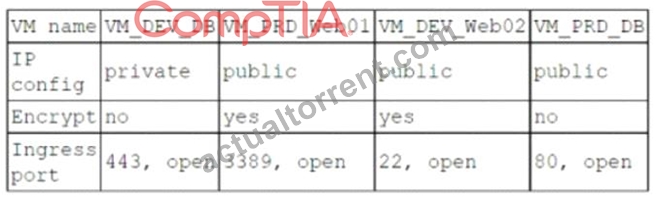
Which of the following should the analyst recommend be updated first to meet the security requirements and reduce risks?
- A. VM_PRD_DB
- B. VM_DEV_Web02
- C. VM_DEV_DB
- D. VM_PRD_Web01
Answer: D
Explanation:
This VM has a public IP and an open port 80, which violates the company's security requirements of no public IPs and no insecure ports/protocols. It also exposes the VM to potential attacks from the internet. This VM should be updated first to use a private IP and close the port 80, or use a secure protocol such as HTTPS.
References[CompTIA CySA+ Study Guide: Exam CS0-003, 3rd Edition], Chapter 2: Cloud and Hybrid Environments, page 67.[What is a Public IP Address?][What is Port 80?]
NEW QUESTION # 11
A systems administrator receives reports of an internet-accessible Linux server that is running very sluggishly. The administrator examines the server, sees a high amount of memory utilization, and suspects a DoS attack related to half-open TCP sessions consuming memory. Which of the following tools would best help to prove whether this server was experiencing this behavior?
- A. EDR
- B. SIEM
- C. TCPDump
- D. Nmap
Answer: C
Explanation:
TCPDump is the best tool to prove whether the server was experiencing a DoS attack related to half-open TCP sessions consuming memory. TCPDump is a command-line tool that can capture and analyze network traffic, such as TCP, UDP, and ICMP packets. TCPDump can help the administrator to identify the source and destination of the traffic, the TCP flags and sequence numbers, the packet size and frequency, and other information that can indicate a DoS attack. A DoS attack related to half-open TCP sessions is also known as a SYN flood attack, which is a type of volumetric attack that aims to exhaust the network bandwidth or resources of the target server by sending a large amount of TCP SYN requests and ignoring the TCP SYN-ACK responses. This creates a backlog of half-open connections on the server, which consume memory and CPU resources, and prevent legitimate connections from being established12. TCPDump can help the administrator to detect a SYN flood attack by looking for a high number of TCP SYN packets with different source IP addresses, a low number of TCP SYN-ACK packets, and a very low number of TCP ACK packets34. Reference: SYN flood DDoS attack | Cloudflare, What is a SYN flood attack and how to prevent it? | NETSCOUT, TCPDump - A Powerful Tool for Network Analysis and Security, How to Detect a SYN Flood Attack with TCPDump
NEW QUESTION # 12
During normal security monitoring activities, the following activity was observed:
cd C:\Users\Documents\HR\Employees
takeown/f .*
SUCCESS:
Which of the following best describes the potentially malicious activity observed?
- A. File configuration changes
- B. Registry changes or anomalies
- C. Unauthorized privileges
- D. Data exfiltration
Answer: C
Explanation:
The takeown command is used to take ownership of a file or folder that previously was denied access to the current user or group12. The activity observed indicates that someone has taken ownership of all files and folders under the C:\Users\Documents\HR\Employees directory, which may contain sensitive or confidential information. This could be a sign of unauthorized privileges, as the user or group may not have the legitimate right or need to access those files or folders. Taking ownership of files or folders could also enable the user or group to modify or delete them, which could affect the integrity or availability of the data.
NEW QUESTION # 13
An analyst has received an IPS event notification from the SIEM stating an IP address, which is known to be malicious, has attempted to exploit a zero-day vulnerability on several web servers. The exploit contained the following snippet:
/wp-json/trx_addons/V2/get/sc_layout?sc=wp_insert_user&role=administrator Which of the following controls would work best to mitigate the attack represented by this snippet?
- A. Set the directory trx_addons to read only for all users.
- B. Set the directory v2 to read only for all users.
- C. Limit layout creation to administrators only.
- D. Limit user creation to administrators only.
Answer: D
Explanation:
Limiting user creation to administrators only would work best to mitigate the attack represented by this snippet. The snippet shows an attempt to exploit a zero-day vulnerability in the ThemeREX Addons WordPress plugin, which allows remote code execution by invoking arbitrary PHP functions via the REST-API endpoint /wp-json/trx_addons/V2/get/sc_layout. In this case, the attacker tries to use the wp_insert_user function to create a new administrator account on the WordPress site12. Limiting user creation to administrators only would prevent the attacker from succeeding, as they would need to provide valid administrator credentials to create a new user. This can be done by using a plugin or a code snippet that restricts user registration to administrators34. Limiting layout creation to administrators only, setting the directory trx_addons to read only for all users, and setting the directory v2 to read only for all users are not effective controls to mitigate the attack, as they do not address the core of the vulnerability, which is the lack of input validation and sanitization on the REST-API endpoint. Moreover, setting directories to read only may affect the functionality of the plugin or the WordPress site56. Reference: Zero-Day Vulnerability in ThemeREX Addons Now Patched - Wordfence, Mitigating Zero Day Attacks With a Detection, Prevention ... - Spiceworks, How to Restrict WordPress User Registration to Specific Email ..., How to Limit WordPress User Registration to Specific Domains, WordPress File Permissions: A Guide to Securing Your Website, WordPress File Permissions: What is the Ideal Setting?
NEW QUESTION # 14
Given the following CVSS string-
CVSS:3.0/AV:N/AC:L/PR:N/UI:N/3:U/C:K/I:K/A:H
Which of the following attributes correctly describes this vulnerability?
- A. A user is required to exploit this vulnerability.
- B. The vulnerability is network based.
- C. The vulnerability does not affect confidentiality.
- D. The complexity to exploit the vulnerability is high.
Answer: B
Explanation:
Explanation
The vulnerability is network based is the correct attribute that describes this vulnerability, as it can be inferred from the CVSS string. CVSS stands for Common Vulnerability Scoring System, which is a framework that assigns numerical scores and ratings to vulnerabilities based on their characteristics and severity. The CVSS string consists of several metrics that define different aspects of the vulnerability, such as the attack vector, the attack complexity, the privileges required, the user interaction, the scope, and the impact on confidentiality, integrity and availability. The first metric in the CVSS string is the attack vector (AV), which indicates how the vulnerability can be exploited. The value of AV in this case is N, which stands for network. This means that the vulnerability can be exploited remotely over a network connection, without physical or logical access to the target system. Therefore, the vulnerability is network based. Official References:
https://partners.comptia.org/docs/default-source/resources/comptia-cysa-cs0-002-exam-objectives
https://www.comptia.org/certifications/cybersecurity-analyst
https://packitforwarding.com/index.php/2019/01/10/comptia-cysa-common-vulnerability-scoring-system-c
NEW QUESTION # 15
A company wants to configure the environment to allow passive network monitoring. To avoid disrupting the sensitive network, which of the following must be supported by the scanner's NIC to assist with the company's request?
- A. Full-duplex mode
- B. Tunnel all mode
- C. Port mirroring
- D. Port bridging
- E. Promiscuous mode
Answer: C
NEW QUESTION # 16
A company is implementing a vulnerability management program and moving from an on-premises environment to a hybrid IaaS cloud environment. Which of the following implications should be considered on the new hybrid environment?
- A. The current scanners should be migrated to the cloud
- B. Existing vulnerability scanners cannot scan laaS systems
- C. Cloud-specific misconfigurations may not be detected by the current scanners
- D. Vulnerability scans on cloud environments should be performed from the cloud
Answer: C
Explanation:
Cloud-specific misconfigurations are security issues that arise from improper or inadequate configuration of cloud resources, such as storage buckets, databases, virtual machines, or containers. Cloud-specific misconfigurations may not be detected by the current scanners that are designed for on-premises environments, as they may not have the visibility or access to the cloud resources or the cloud provider's APIs. Therefore, one of the implications that should be considered on the new hybrid environment is that cloud-specific misconfigurations may not be detected by the current scanners.
NEW QUESTION # 17
A cybersecurity team has witnessed numerous vulnerability events recently that have affected operating systems. The team decides to implement host-based IPS, firewalls, and two-factor authentication. Which of the following does this most likely describe?
- A. System hardening
- B. Hybrid network architecture
- C. Continuous authorization
- D. Secure access service edge
Answer: A
Explanation:
Explanation
The correct answer is A. System hardening.
System hardening is the process of securing a system by reducing its attack surface, applying patches and updates, configuring security settings, and implementing security controls. System hardening can help prevent or mitigate vulnerability events that may affect operating systems. Host-based IPS, firewalls, and two-factor authentication are examples of security controls that can be applied to harden a system1.
The other options are not the best descriptions of the scenario. A hybrid network architecture (B) is a network design that combines on-premises and cloud-based resources, which may or may not involve system hardening. Continuous authorization is a security approach that monitors and validates the security posture of a system on an ongoing basis, which is different from system hardening. Secure access service edge (D) is a network architecture that delivers cloud-based security services to remote users and devices, which is also different from system hardening.
NEW QUESTION # 18
A company has a primary control in place to restrict access to a sensitive database. However, the company discovered an authentication vulnerability that could bypass this control. Which of the following is the best compensating control?
- A. Implementing intrusion detection software to alert security teams of unauthorized access attempts
- B. Running regular penetration tests to identify and address new vulnerabilities
- C. Deploying an additional layer of access controls to verify authorized individuals
- D. Conducting regular security awareness training of employees to prevent social engineering attacks
Answer: C
Explanation:
Deploying an additional layer of access controls to verify authorized individuals is the best compensating control for the authentication vulnerability that could bypass the primary control. A compensating control is a security measure that is implemented to mitigate the risk of a vulnerability or a threat when the primary control is not sufficient or feasible. A compensating control should provide a similar or greater level of protection as the primary control, and should be closely related to the vulnerability or the threat it is addressing1. In this case, the primary control is to restrict access to a sensitive database, and the vulnerability is an authentication bypass. Therefore, the best compensating control is to deploy an additional layer of access controls, such as multifactor authentication, role-based access control, or encryption, to verify the identity and the authorization of the individuals who are accessing the database. This way, the compensating control can prevent unauthorized access to the database, even if the primary control is bypassed23. Running regular penetration tests, conducting regular security awareness training, and implementing intrusion detection software are all good security practices, but they are not compensating controls for the authentication vulnerability, as they do not provide a similar or greater level of protection as the primary control, and they are not closely related to the vulnerability or the threat they are addressing. Reference: Compensating Controls: An Impermanent Solution to an IT ... - Tripwire, What is Multifactor Authentication (MFA)? | Duo Security, Role-Based Access Control (RBAC) and Role-Based Security, [What is a Penetration Test and How Does It Work?]
NEW QUESTION # 19
The vulnerability analyst reviews threat intelligence regarding emerging vulnerabilities affecting workstations that are used within the company: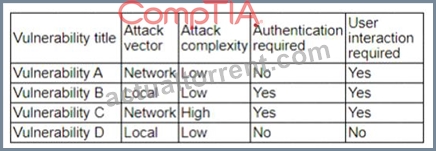
Which of the following vulnerabilities should the analyst be most concerned about, knowing that end users frequently click on malicious links sent via email?
- A. Vulnerability B
- B. Vulnerability A
- C. Vulnerability C
- D. Vulnerability D
Answer: A
Explanation:
Vulnerability B is the vulnerability that the analyst should be most concerned about, knowing that end users frequently click on malicious links sent via email. Vulnerability B is a remote code execution vulnerability in Microsoft Outlook that allows an attacker to run arbitrary code on the target system by sending a specially crafted email message. This vulnerability is very dangerous, as it does not require any user interaction or attachment opening to trigger the exploit. The attacker only needs to send an email to the victim's Outlook account, and the code will execute automatically when Outlook connects to the Exchange server. This vulnerability has a high severity rating of 9.8 out of 10, and it affects all supported versions of Outlook.
Therefore, the analyst should prioritize patching this vulnerability as soon as possible to prevent potential compromise of the workstations.
NEW QUESTION # 20
A vulnerability analyst received a list of system vulnerabilities and needs to evaluate the relevant impact of the exploits on the business. Given the constraints of the current sprint, only three can be remediated. Which of the following represents the least impactful risk, given the CVSS3.1 base scores?
- A. AV:N/AC:H/PR:N/UI:N/S:C/C:L/I:L/A:L - Base Score 6.5
- B. AV:N/AC:H/PR:H/UI:N/S:C/C:H/I:L/A:L - Base Score 7.2
- C. AV:N/AC:H/PR:H/UI:R/S:U/C:H/I:H/A:H - Base Score 6.4
- D. AV:N/AC:H/PR:H/UI:R/S:U/C:H/I:H/A:L - Base Score 6.0
Answer: D
Explanation:
This option represents the least impactful risk because it has the lowest base score among the four options, and it also requires high privileges, user interaction, and high attack complexity to exploit, which reduces the likelihood of a successful attack.
References: The base scores were calculated using the Common Vulnerability Scoring System Version 3.1 Calculator from FIRST. The explanation was based on the CVSS standards guide from NVD and the CVSS
3.1 Calculator Online from Calculators Hub.
NEW QUESTION # 21
During a scan of a web server in the perimeter network, a vulnerability was identified that could be exploited over port 3389. The web server is protected by a WAF. Which of the following best represents the change to overall risk associated with this vulnerability?
- A. The risk would decrease because a web application firewall is in place.
- B. The risk would decrease because RDP is blocked by the firewall.
- C. The risk would increase because the host is external facing.
- D. The risk would not change because network firewalls are in use.
Answer: B
Explanation:
Port 3389 is commonly used by Remote Desktop Protocol (RDP), which is a service that allows remote access to a system. A vulnerability on this port could allow an attacker to compromise the web server or use it as a pivot point to access other systems. However, if the firewall blocks this port, the risk of exploitation is reduced.
References: CompTIA CySA+ CS0-003 Certification Study Guide, Chapter 2: Software and Systems Security, page 67; CompTIA CySA+ Study Guide: Exam CS0-003, 3rd Edition, Chapter 3: Software and Systems Security, page 103.
NEW QUESTION # 22
A security officer needs to find the most cost-effective solution to the current data privacy and protection gap found in the last security assessment.
Which of the following is the BEST recommendation?
- A. Require users to sign NDAs
- B. Implement a data loss prevention solution
- C. Create a data minimization plan.
- D. Add access control requirements
Answer: C
NEW QUESTION # 23
Which of the following would an organization use to develop a business continuity plan?
- A. A repository for all the software used by the organization
- B. A diagram of all systems and interdependent applications
- C. A prioritized list of critical systems defined by executive leadership
- D. A configuration management database in print at an off-site location
Answer: C
NEW QUESTION # 24
Which of the following best describes the reporting metric that should be utilized when measuring the degree to which a system, application, or user base is affected by an uptime availability outage?
- A. Scope
- B. Evidence
- C. Impact
- D. Timeline
Answer: C
Explanation:
Explanation
The correct answer is C. Impact.
The impact metric is the best way to measure the degree to which a system, application, or user base is affected by an uptime availability outage. The impact metric quantifies the consequences of the outage in terms of lost revenue, productivity, reputation, customer satisfaction, or other relevant factors. The impact metric can help prioritize the recovery efforts and justify the resources needed to restore the service1.
The other options are not the best ways to measure the degree to which a system, application, or user base is affected by an uptime availability outage. The timeline metric (A) measures the duration and frequency of the outage, but not its effects. The evidence metric (B) measures the sources and types of data that can be used to investigate and analyze the outage, but not its effects. The scope metric (D) measures the extent and severity of the outage, but not its effects.
NEW QUESTION # 25
A cybersecurity analyst is researching operational data to develop a script that will detect the presence of a threat on corporate assets. Which of the following contains the most useful information to produce this script?
- A. OpenloC files
- B. MITRE ATT&CK reports
- C. Protocol analysis captures
- D. API documentation
Answer: B
Explanation:
A cybersecurity analyst is researching operational data to develop a script that will detect the presence of a threat on corporate assets. The most useful information to produce this script is MITRE ATT&CK reports. MITRE ATT&CK is a knowledge base of adversary tactics and techniques based on real-world observations. MITRE ATT&CK reports provide detailed information on how different threat actors operate, what tools they use, what indicators they leave behind, and how to detect or mitigate their attacks. The other options are not as useful or relevant for this purpose. Reference: CompTIA Cybersecurity Analyst (CySA+) Certification Exam Objectives (CS0-002), page 9; https://attack.mitre.org/
NEW QUESTION # 26
A security analyst is reviewing the logs of a web server and notices that an attacker has attempted to exploit a SQL injection vulnerability. Which of the following tools can the analyst use to analyze the attack and prevent future attacks?
- A. A web proxy
- B. A vulnerability scanner
- C. A web application firewall
- D. A network intrusion detection system
Answer: C
Explanation:
A web application firewall (WAF) is a tool that can protect web servers from attacks such as SQL injection, cross-site scripting, and other web-based threats. A WAF can filter, monitor, and block malicious HTTP traffic before it reaches the web server. A WAF can also be configured with rules and policies to detect and prevent specific types of attacks.
Reference:
CompTIA CySA+ Study Guide: Exam CS0-002, 2nd Edition : CompTIA CySA+ Certification Exam Objectives Version 4.0.pdf)
NEW QUESTION # 27
Which of the following best describes the importance of implementing TAXII as part of a threat intelligence program?
- A. It proactively facilitates real-time information sharing between the public and private sectors.
- B. It provides a structured way to gain information about insider threats.
- C. It exchanges messages in the most cost-effective way and requires little maintenance once implemented.
- D. It is a semi-automated solution to gather threat intellbgence about competitors in the same sector.
Answer: A
Explanation:
The correct answer is B. It proactively facilitates real-time information sharing between the public and private sectors.
TAXII, or Trusted Automated eXchange of Intelligence Information, is a standard protocol for sharing cyber threat intelligence in a standardized, automated, and secure manner. TAXII defines how cyber threat information can be shared via services and message exchanges, such as discovery, collection management, inbox, and poll. TAXII is designed to support STIX, or Structured Threat Information eXpression, which is a standardized language for describing cyber threat information in a readable and consistent format. Together, STIX and TAXII form a framework for sharing and using threat intelligence, creating an open-source platform that allows users to search through records containing attack vectors details such as malicious IP addresses, malware signatures, and threat actors123.
The importance of implementing TAXII as part of a threat intelligence program is that it proactively facilitates real-time information sharing between the public and private sectors. By using TAXII, organizations can exchange cyber threat information with various entities, such as security vendors, government agencies, industry associations, or trusted groups. TAXII enables different sharing models, such as hub and spoke, source/subscriber, or peer-to-peer, depending on the needs and preferences of the information producers and consumers. TAXII also supports different levels of access control, encryption, and authentication to ensure the security and privacy of the shared information123.
By implementing TAXII as part of a threat intelligence program, organizations can benefit from the following advantages:
They can receive timely and relevant information about the latest threats and vulnerabilities that may affect their systems or networks.
They can leverage the collective knowledge and experience of other organizations that have faced similar or related threats.
They can improve their situational awareness and threat detection capabilities by correlating and analyzing the shared information.
They can enhance their incident response and mitigation strategies by applying the best practices and recommendations from the shared information.
They can contribute to the overall improvement of cyber security by sharing their own insights and feedback with other organizations123.
The other options are incorrect because they do not accurately describe the importance of implementing TAXII as part of a threat intelligence program.
Option A is incorrect because TAXII does not provide a structured way to gain information about insider threats. Insider threats are malicious activities conducted by authorized users within an organization, such as employees, contractors, or partners. Insider threats can be detected by using various methods, such as user behavior analysis, data loss prevention, or anomaly detection. However, TAXII is not designed to collect or share information about insider threats specifically. TAXII is more focused on external threats that originate from outside sources, such as hackers, cybercriminals, or nation-states4.
Option C is incorrect because TAXII does not exchange messages in the most cost-effective way and requires little maintenance once implemented. TAXII is a protocol that defines how messages are exchanged, but it does not specify the cost or maintenance of the exchange. The cost and maintenance of implementing TAXII depend on various factors, such as the type and number of services used, the volume and frequency of data exchanged, the security and reliability requirements of the exchange, and the availability and compatibility of existing tools and platforms. Implementing TAXII may require significant resources and efforts from both the information producers and consumers to ensure its functionality and performance5.
Option D is incorrect because TAXII is not a semi-automated solution to gather threat intelligence about competitors in the same sector. TAXII is a fully automated solution that enables the exchange of threat intelligence among various entities across different sectors. TAXII does not target or collect information about specific competitors in the same sector. Rather, it aims to foster collaboration and cooperation among organizations that share common interests or goals in cyber security. Moreover, gathering threat intelligence about competitors in the same sector may raise ethical and legal issues that are beyond the scope of TAXII.
References:
1 What is STIX/TAXII? | Cloudflare
2 What Are STIX/TAXII Standards? - Anomali Resources
3 What is STIX and TAXII? - EclecticIQ
4 What Is an Insider Threat? Definition & Examples | Varonis
5 Implementing STIX/TAXII - GitHub Pages
[6] Cyber Threat Intelligence: Ethical Hacking vs Unethical Hacking | Infosec
NEW QUESTION # 28
......
The CySA+ certification is an important credential for IT professionals who are looking to advance their careers in cybersecurity. CompTIA Cybersecurity Analyst (CySA+) Certification Exam certification is recognized by major tech companies and government agencies, and is a requirement for many cybersecurity jobs. The CySA+ certification is also a stepping stone to other advanced cybersecurity certifications, such as the Certified Information Systems Security Professional (CISSP) and Certified Ethical Hacker (CEH) certifications.
CompTIA Cybersecurity Analyst (CySA+) certification exam, also known as CS0-003, is a highly respected and in-demand certification in the field of cybersecurity. CompTIA Cybersecurity Analyst (CySA+) Certification Exam certification provides candidates with the knowledge and skills necessary to analyze data and identify potential cyber threats, as well as develop and implement effective cybersecurity strategies. CompTIA Cybersecurity Analyst (CySA+) Certification Exam certification is recognized globally and is highly respected by employers, making it an essential certification for anyone looking to advance their career in cybersecurity.
The CS0-003 certification exam is an ideal choice for IT professionals who want to advance their careers in the cybersecurity industry. CompTIA Cybersecurity Analyst (CySA+) Certification Exam certification is recognized by leading organizations such as the U.S. Department of Defense, and it is a requirement for many cybersecurity positions in both the public and private sectors. CompTIA Cybersecurity Analyst (CySA+) Certification Exam certification can also help professionals to earn higher salaries and gain recognition for their expertise in the field.
Real Updated CS0-003 Questions & Answers Pass Your Exam Easily: https://passking.actualtorrent.com/CS0-003-exam-guide-torrent.html