

[Jan 20, 2023] Latest SAP Certified Application Associate C-HANAIMP-18 Actual Free Exam Questions
SAP Certified Application Associate C-HANAIMP-18 Dumps Updated Practice Test and 82 unique questions
NEW QUESTION 28
What are some best practices when developing calculation views?Note: There are 2 correct answers to this question.
- A. Aggregate at the lowest possible node.
- B. Avoid defining joins on calculated columns.
- C. Model star schemas using a sequence of join nodes.
- D. Include all data flow logic within one calculation view.
Answer: A,C
NEW QUESTION 29
Why would you create SQL in calculation views?
- A. To provide an alternative to graphical modeling
- B. To fine-tune performance
- C. To implement custom logic
- D. To enable write capabilities
Answer: C
NEW QUESTION 30
Which are the components of SAP HANA Cloud?Note: There are 3 correct answers to this question.
- A. SAP HANA Cloud data lake
- B. Native Storage Extension
- C. SAP Analytics Cloud
- D. SAP Data Warehouse Cloud
- E. SAP HANA in-memory database
Answer: A,C,D
NEW QUESTION 31
You created a calculation view that combines two tables in a join node. To improve the runtime of your calculation view, you use a referential join to prune data sources.How do you check if pruning occurs?Note:
There are 2 correct answers to this question.
- A. Enable Debug Query mode to identify the columns used
- B. Use the SQL Analyzer to identify the tables used
- C. Explore the number of used columns in the Performance Analysis mode
- D. Preview the data results in the calculation view
Answer: A,C
NEW QUESTION 32
You implement a referential join between Table A and Table B, but when you query the calculation view, Table B is not pruned.What could be the problem?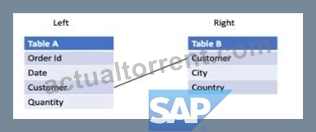
Note: There are 2 correct answers to this question.
- A. The Keep flag is activated for the Customer column.
- B. Join cardinality is set :1.
- C. Integrity constraint is set to RIGHT.
- D. The Country column is requested.
Answer: A,C
NEW QUESTION 33
Why do we use Git when modeling calculation views?Note: There are 2 correct answers to this question.
- A. To enable collaboration between developers
- B. To manage versions of source files
- C. To automate the build process
- D. To display dependencies in stacked scenarios
Answer: A,B
NEW QUESTION 34
You want to join two tables in a calculation view.Why do you use a non-equi join?
- A. Join columns need to be ignored when NOT requested by the query.
- B. The number of joined columns is different in each table.
- C. The join condition is not represented by matching values.
- D. Join columns have different data types.
Answer: C
NEW QUESTION 35
You want to map an input parameter of calculation view A to an input parameter of calculation view B using the parameter mapping feature in the calculation view editor. However, the input parameters of calculation view B are not proposed as source parameters.What might be the reason for this?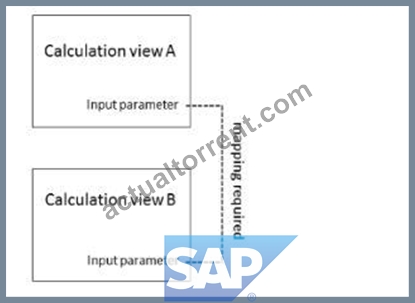
- A. You selected the wrong parameter mapping TYPE.
- B. You already mapped the input parameters in another calculation view.
- C. Your source calculation view is of type DIMENSION.
- D. The names of the input parameters do not match.
Answer: B
NEW QUESTION 36
You set the Null Handling property for an attribute but do not set a default value.What is displayed when null values are found in a column of data type NVARCHAR?
- A. "Null"
- B. <empty string>
- C. "?"
- D. "0"
Answer: B
NEW QUESTION 37
Which of the following data sources can you include in a graphical calculation view?Note: There are 2 correct answers to this question.
- A. Scalar function
- B. Row table
- C. Table function
- D. Procedure
Answer: B,C
NEW QUESTION 38
You have generated a calculation view properties file.What does it contain?
- A. Descriptions of all objects defined in a calculation view
- B. All settings defined in a calculation view
- C. Documentation to support the calculation view
- D. Dependencies between calculation views
Answer: A
NEW QUESTION 39
What can you identify using Performance Analysis mode?Note: There are 2 correct answers to this question.
- A. Usage statistics of the calculation view
- B. Joins that are defined on calculated columns
- C. Expected memory consumption
- D. Information about join cardinality
Answer: B,D
NEW QUESTION 40
You combine two tables in a join node using multiple columns in each table.Why do you enable the dynamic join option?Note: There are 2 correct answers to this question.
- A. To force the calculation at the relevant level of granularity, even if this level is not the grouping level defined by the query
- B. To ensure that the join execution only uses the join columns requested in the query
- C. To allow data analysis at different levels of granularity with the same calculation view
- D. To ensure that the aggregation always happens after the join execution
Answer: B,C
NEW QUESTION 41
What are the limitations of using a full outer join in a star join node?Note: There are 2 correct answers to this question.
- A. Only one column can be included in the join condition.
- B. It is restricted to one DIMENSION in a star join node.
- C. It CANNOT be mixed in the same star join node with other join types.
- D. It must appear in the last DIMENSION in the star join node.
Answer: B,D
NEW QUESTION 42
Which of the following are capabilities of SAP HANA smart data access?Note: There are 2 correct answers to this question.
- A. Cleansing and harmonization of data from disparate sources
- B. Exposure of real-time data from remote tables
- C. Push-down of queries to remote data sources
- D. Replication of remote data
Answer: B,C
NEW QUESTION 43
......
Verified C-HANAIMP-18 dumps Q&As - 100% Pass from ActualTorrent: https://passking.actualtorrent.com/C-HANAIMP-18-exam-guide-torrent.html