

Prepare With Top Rated High-quality Network-Security-Essentials Dumps For Success in Network-Security-Essentials Exam
Network-Security-Essentials Free Certification Exam Easy to Download PDF Format 2025
NEW QUESTION # 16
The Firebox can scan the contents of encrypted zip files with Gateway AntiVirus when HTTPS content inspection is enabled.
- A. False
- B. True
Answer: A
Explanation:
The Firebox cannot scan the contents of encrypted zip files even if HTTPS content inspection is enabled.
HTTPS content inspection allows the Firebox to inspect encrypted HTTPS traffic by decrypting it. However, the content within encrypted zip files remains inaccessible to Gateway AntiVirus scanning because the encryption key for the zip file is not available to the Firebox. This limitation is consistent with standard network security practices, where encrypted files need to be decrypted with a known key before content scanning can occur.
NEW QUESTION # 17
After you enable content inspection, your users see a certificate warning when they browse the Internet. What is one way to resolve this? (Select one.)
- A. Install the current Firebox Proxy Authority certificate on your user workstations
- B. Configure the HTTPS proxy policy to allow inbound traffic from your CA
- C. Configure a WebBlocker exception for your certificate server
- D. Import a trusted web server certificate to the Firebox
Answer: A
Explanation:
When content inspection is enabled on a Firebox, it decrypts HTTPS traffic for inspection, which requires presenting its own certificate to the client devices. This often causes certificate warnings in web browsers because the certificate issued by the Firebox is not inherently trusted by the client browsers. To resolve this, you need to install the Firebox'sProxy Authority certificateon each user's workstation as a trusted certificate. This action will prevent browsers from displaying certificate warnings, as they will recognize the Firebox certificate as a trusted source for secure connections.
NEW QUESTION # 18
What type of NAT enables clients on a private network to connect to servers on the Internet? (Select one.)
- A. Hairpin NAT
- B. NAT loopback
- C. Static NAT
- D. Dynamic NAT
Answer: D
Explanation:
Dynamic NAT enables clients on a private network to connect to servers on the Internet. By translating private IP addresses to a public IP address (or pool of addresses), Dynamic NAT allows multiple devices within a private network to access external resources on the Internet. This form of NAT is essential in conserving IP addresses and maintaining privacy for internal network topologies.
NEW QUESTION # 19
Match each WatchGuard Subscription Service with its function.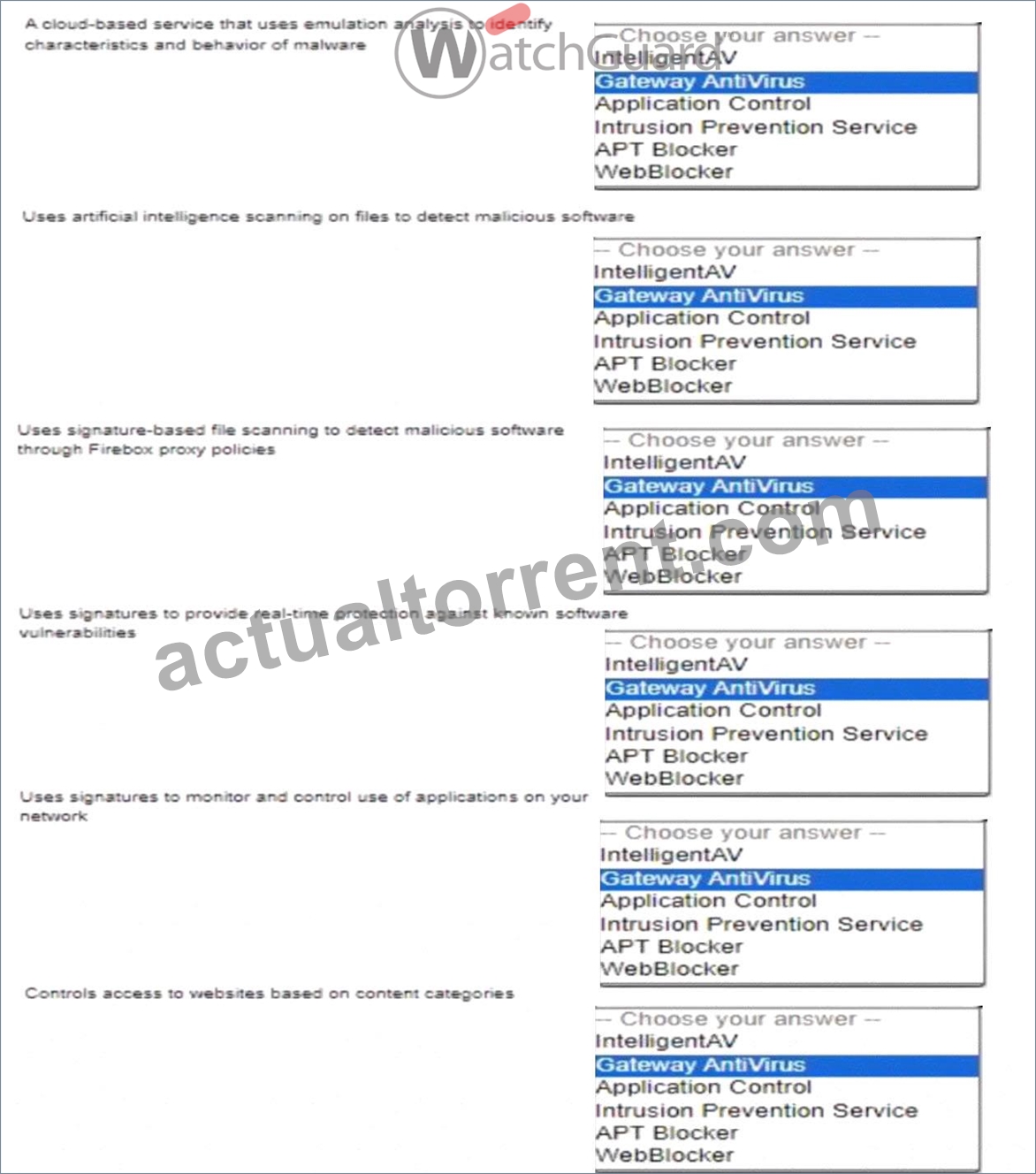
Answer:
Explanation:
Explanation:
Here is the correct match for each WatchGuard Subscription Service and its function:
* A cloud-based service that uses emulation analysis to identify characteristics and behavior of malware : APT Blocker
* Uses artificial intelligence scanning on files to detect malicious software : IntelligentAV
* Uses signature-based file scanning to detect malicious software through Firebox proxy policies : Gateway AntiVirus
* Uses signatures to provide real-time protection against known software vulnerabilities : Intrusion Prevention Service
* Uses signatures to monitor and control use of applications on your network : Application Control
* Controls access to websites based on content categories : WebBlocker APT Blockeris a cloud-based, advanced threat detection service that performs behavioral analysis in a sandbox environment to identify sophisticated malware.
It focuses on identifying advanced persistent threats (APT) by observing their behavior in a controlled setting.
IntelligentAVleverages artificial intelligence to perform deep scanning and analysis of files to detect malware using predictive modeling techniques. This provides proactive protection by identifying previously unknown threats.
Gateway AntiVirusrelies on a signature-based detection mechanism to identify malware in real-time. It is used within Firebox's proxy policies to scan file transfers, ensuring files containing known malware are blocked.
Intrusion Prevention Service (IPS)scans network traffic against a database of known vulnerabilities to detect and prevent exploitation attempts in real time. It protects against network-based attacks targeting known vulnerabilities.
Application Controlhelps in monitoring, managing, and enforcing the use of applications across the network using a signature-based approach. It provides visibility and control over applications to enhance productivity and security.
WebBlockeris a content filtering service that restricts access to websites based on their content categories. It helps enforce web usage policies and block access to inappropriate or harmful content.
NEW QUESTION # 20
You enable a network device monitoring application on a server with IP address 10.0.1.22. After you run the application, it reports that it cannot ping the Firebox at 10.0.1.1, and you see this log message in Traffic Monitor. What is the most likely cause of this issue? (Select one.)
- A. The dynamic NAT statement is not configured correctly for the 10.0.1.0/24 subnet
- B. There is no route on the Firebox for the 10.0.1.0/24 subnet
- C. The default Unhandled Internal Packet policy is at the top of the policy set
- D. The server IP address is on the Blocked Sites list
- E. There is no policy that allows Ping traffic from the server to the Firebox alias
Answer: E
Explanation:
The most likely reason for the network device monitoring application's failure to ping the Firebox is the absence of an explicit policy permitting Ping traffic from the server (IP 10.0.1.22) to the Firebox alias (10.0.1.1). By default, Firebox policies are configured to allow only traffic explicitly permitted by a policy.
Therefore, without a dedicated policy allowing ICMP (Ping) requests from this specific source to the Firebox, the device will drop the traffic, resulting in a connectivity failure for Ping.
This is a common scenario in Firebox configurations, where restrictive policy settings enhance network security by blocking all traffic types unless specifically allowed.
NEW QUESTION # 21
You configured a Firebox for a school environment. Students must have more restricted access than teachers, and unauthenticated users cannot have any Internet access. You added Student and Teacher groups to your proxy policies that handle web traffic. Based on the image below, this configuration can accomplish your goals.
- A. False
- B. True
Answer: B
Explanation:
The image shows a configuration for a school environment with separateHTTPandHTTPS proxy policiesfor StudentsandTeachers. This separation allows for different levels of access control based on group membership, providing more restrictive access for students compared to teachers.
* Studentsare restricted by specific HTTP and HTTPS proxy policies, limiting their access to designated content and sites.
* Teachershave their own policies, which can be configured with more permissive rules.
* Unauthenticated users are not included in any policy, effectively blocking their internet access, as the firewall denies traffic not explicitly allowed by a policy.
This configuration meets the requirements by:
* Allowing teachers and students access as per their respective policies.
* Blocking unauthenticated users from internet access entirely.
NEW QUESTION # 22
Which of these statements are true for this log message? (Select three.)
- A. The connection used an HTTP Proxy
- B. The connection was denied
- C. Gateway AntiVirus detected a virus
- D. The connection used an HTTP Packet Filter
- E. Application Control detected the application as a virus
- F. The URL path matched the proxy content type restrictions
Answer: A,B,C
Explanation:
Analyzing a typical Firebox log message for a denied connection with an associated virus detection involves recognizing multiple elements:
* HTTP Proxy Detection (C): If the connection utilized an HTTP proxy, this is typically noted in the log. Firebox's HTTP proxy is often used to inspect and manage web traffic, including scanning for malicious content.
* Gateway AntiVirus Detection (D): This service scans HTTP traffic for malware and will generate log messages if it identifies a virus. When a virus is detected, the action taken is generally to block the connection.
* Connection Denial (E): When a threat is detected (e.g., a virus via Gateway AntiVirus), Firebox policies are configured to deny the connection to prevent potential infection or data breaches. This is logged as a denied connection.
Other options, such as Application Control detecting a virus or the use of an HTTP Packet Filter, are not relevant in this context based on the function of HTTP proxies and Gateway AntiVirus in Firebox logs.
NEW QUESTION # 23
The Audit Trail report shows information about Firebox configuration changes. How can you makesure the Audit Trail report includes the names of the specific person that made each change? (Select one.)
- A. Install the SSO Client on each computer used by Firebox administrators
- B. Enable the Logging > AuditTrack feature
- C. Create unique device administrator accounts for each Firebox administrative user
- D. Configure your RADIUS server to send accounting messages to the Firebox
- E. Configure all Firebox administrators to use the Authentication Portal to log in to the Firebox
Answer: C
Explanation:
To ensure that the Audit Trail report in Firebox includes the specific names of administrators making configuration changes, it is essential to have unique device administrator accounts. This setup allows each administrative action to be associated with a specific user, enabling detailed tracking of configuration modifications. By differentiating user accounts, the system can log the specific username associated with each change, fulfilling audit and compliance requirements.
NEW QUESTION # 24
You bought a new Firebox and want to use the configuration from an existing Firebox you already configured. The best way to migrate the configuration is to restore a backup image from the existing Firebox to the new Firebox, then add the new feature key.
- A. False
- B. True
Answer: B
Explanation:
When migrating configurations from one Firebox to another, restoring a backup image from the existing Firebox to the new one is a valid and efficient method. This approach will transfer all configuration settings, policies, and security settings to the new Firebox. After restoring the backup, you need to add the new feature key specific to the new Firebox, as feature keys are unique to each device. This method preserves the existing configurations while adapting the setup for the new hardware.
NEW QUESTION # 25
You configured email notifications in WatchGuard Cloud for your Firebox Device Alarms and want to receive an email when your users download any .exe files through an HTTP proxy. You must enable what type of log message in the Firebox configuration? (Select one.)
- A. Alarm logs for the EXE/DLL Body Content rule in the HTTP proxy
- B. Denied traffic logs for the HTTP proxy policy
- C. Diagnostic logs for Gateway AntiVirus
- D. Alarm logs for when a virus is detected in the HTTP proxy
- E. Allowed traffic logs for the HTTP proxy policy
Answer: A
Explanation:
To receive email notifications when users download .exe files through an HTTP proxy, you need to enable Alarm logs for the EXE/DLL Body Content rulein the HTTP proxy configuration on the Firebox. This setting ensures that alerts are triggered whenever executable files are detected, and WatchGuard Cloud can send notifications based on these alarms.
Other logging options, such as allowed or denied traffic logs, would not provide the specific alerts required for .exe file downloads through the proxy.
NEW QUESTION # 26
Which of these is a network IP address? (Select one.)
- A. 1Q2 158.10 0-24
- B. 1G2 153 10 O 1
- C. 10 10 10 255/24
- D. 10 0.1 255 8
- E. 172 16 100 1/12
Answer: C
Explanation:
In this question, we need to identify the correctly formatted network IP address. IPv4 addresses are represented in a dotted decimal format, typically in the form of x.x.x.x/n, where x represents decimal values from 0 to 255, and /n is the CIDR notation indicating the subnet mask. Among the options:
* Option E (10 10 10 255/24)fits the IPv4 standard and CIDR notation.
* The other options contain invalid characters or formats (letters like "G" or "Q" or unusual symbols like
"O" or "-") and do not conform to IP addressing standards.
NEW QUESTION # 27
You can run TCP Dump directly from the Firebox.
- A. False
- B. True
Answer: A
Explanation:
You cannot runTCP Dumpdirectly from a Firebox device. While Firebox has various monitoring tools such as Traffic Monitor and Firebox System Manager, it does not natively support TCP Dump, which is a command-line tool primarily available on Linux-based systems. Instead, packet captures and traffic monitoring need to be handled through Firebox-specific tools or by exporting logs to external devices for further analysis.
NEW QUESTION # 28
A Firebox has an external IP address of 203.0.113.100. A public web server with the IP address 10.0.1.80 is connected to a Firebox internal network. What is the effect of the policy shown in this image? (Select one.)
- A. Applies dynamic NAT to the 10.0.1.80 IP address of the web server to allow inbound connections
- B. Allows users on the Internet and the 10.0.1.0/24 network to use the internal IP address of the Firebox to connect to the web server
- C. Allows users on the Internet to connect to the 10.0.1.80 IP address of the web server
- D. Allows users on the Internet and the 10.0.1.0/24 network to use the external IP address of the Firebox to connect to the web server
Answer: D
Explanation:
In the policy configuration shown in the image:
* From Section: It specifies "Any-External" and 10.0.1.0/24, indicating that this policy applies to traffic from any external source (Internet users) as well as from devices on the internal network 10.0.1.0/24.
* To Section: The destination specifies a public-facing IP address (203.0.113.100) that is statically NAT'd to the internal IP address of the web server (10.0.1.80). This means external users and internal users can access the web server using the Firebox's external IP.
* Effect of Static NAT: The policy uses Static NAT to map the Firebox's external IP address to the web server's internal IP address, allowing inbound connections to reach the server. This setup provides consistent access for both external and internal users via the same public IP address.
This configuration effectively enables both Internet users and users within the specified internal network (10.0.1.0/24) to connect to the web server using the Firebox's external IP, makingOption Dthe correct answer.
NEW QUESTION # 29
Some management tasks require you to use a specific management interface. Match the task below with the management interface that supports it.
Answer:
Explanation:
Explanation:
Here are the correct answers based on typical Firebox management interface capabilities:
* Edit a configuration file without being connected to a Fireboxanswer: Policy Manager Policy Manager allows administrators to edit a Firebox configuration file offline without a direct connection to the Firebox. This feature is helpful for preparing configuration changes in advance.
* Run Policy Checkeranswer: Policy Manager
The Policy Checker tool is included in Policy Manager, which checks configuration settings for errors before applying them. This tool provides an essential layer of validation, preventing misconfigurations.
* View the Firebox Status Reportanswer: Firebox System Manager
The Firebox System Manager (FSM) interface provides real-time status reporting on device health, traffic, and security services, which includes viewing the Firebox Status Report.
* Schedule a Firebox OS updateanswer: Fireware Web UI
Fireware Web UI includes options for scheduling OS updates for the Firebox, which can be managed remotely through a web interface.
These answers align with standard Firebox network security essentials and their recommended management interfaces for specific administrative tasks. Let me know if you need further assistance with related Firebox management topics
NEW QUESTION # 30
You have five public IP addresses available from your ISP. When you create a Static NAT action, you want to specify one of the public IP addresses for inbound traffic but do not see it in the IP address drop-down list.
How can you change the Firebox configuration to see additional public IP addresses in the Static NAT action?
(Select one.)
- A. Add secondary IP addresses to the external interface
- B. Configure 1-to-1 NAT for your entire subnet
- C. Add the IP addresses to the Dynamic NAT configuration
- D. Add the public IP addresses to the From field of the policy that uses the Static NAT action
- E. Enable the Set Source IP option in the policy
Answer: A
Explanation:
To use additional public IP addresses in a Static NAT action, you need to add them as secondary IP addresses to the external interface on the Firebox. By adding these IPs as secondary addresses, they become selectable options in the Static NAT configuration, allowing inbound traffic to be routed based on specific public IPs allocated by the ISP.
NEW QUESTION # 31
You have just configured Mobile VPN with IKEv2 for your customer. By default, authenticated Mobile VPN users are allowed to send traffic to all Firebox networks through the VPN.
- A. False
- B. True
Answer: A
Explanation:
In the default configuration ofMobile VPN with IKEv2, authenticated VPN users are only allowed access to specified networks or resources as defined by the VPN policy. They do not automatically have access to all Firebox networks through the VPN. To enable access to specific networks, administrators need to configure access routes explicitly within the Mobile VPN settings.
NEW QUESTION # 32
After you enable content inspection, your users cannot connect to the business-critical website www.example.
com/account.html hosted by a trusted partner. To try to resolve this issue, you added a Domain Name exception of www.example.com/account.html, but users still cannot connect to the website. What is the Domain Name exception format to add to the HTTP proxy to correctly resolve this issue? (Select two.)
- A. example.com/
- B. /example.com/
- C. *.example.com
- D. /account.html
- E. www.example.com
Answer: C,E
Explanation:
When using domain exceptions to bypass content inspection for specific websites on a Firebox, the format is critical. For the domain www.example.com/account.html, two viable exception formats are:
* A. *.example.com: This wildcard format will include all subdomains of example.com, covering www.
example.com as well as any other subdomains like api.example.com. This format is useful when you need to exclude an entire domain and its subdomains from content inspection.
* D. www.example.com: This specifies the exact domain. Adding this as an exception will directly match www.example.com, making it suitable for bypassing content inspection on that specific subdomain.
Other formats, like /example.com/ or /account.html, do not match the required structure for domain name exceptions in the Firebox HTTP proxy settings.
NEW QUESTION # 33
To accurately detect applications over an HTTPS connection with Application Control, you must enable content inspection in the HTTPS proxy.
- A. False
- B. True
Answer: B
Explanation:
For Application Control to accurately detect and manage applications over HTTPS connections, content inspection must be enabled in the HTTPS proxy. This is because HTTPS encrypts application traffic, making it unreadable without decryption. By enabling content inspection, the HTTPS proxy can inspect and classify the application traffic within HTTPS sessions, allowing Application Control to function effectively on secure connections.
NEW QUESTION # 34
You want to create a branch office VPN virtual interface between a remote Firebox and your headquarters Firebox so the remote Firebox can send log data to a server at headquarters. For the log data to be sent from the remote Firebox over the VPN successfully, what BOVPN virtual interface setting must you configure?
(Select one.)
- A. Dead Peer Detection (DPD)
- B. Virtual IP addresses
- C. IKEv2 in the Phase 1 settings
- D. Perfect Forward Secrecy (PFS)
- E. An IPSec certificate, instead of a Pre-shared key
Answer: B
Explanation:
To enable the remote Firebox to send log data to a server at headquarters through a Branch Office VPN (BOVPN) virtual interface, you must configureVirtual IP addresses. Virtual IPs enable devices on either end of the VPN tunnel to communicate as if they are on the same network, facilitating routing of log data from the remote Firebox to the log server located at headquarters.
Other options likeIPSec certificatesandIKEv2are not specifically required for this configuration, though they can enhance security.Dead Peer Detection (DPD)andPerfect Forward Secrecy (PFS)are useful for maintaining VPN stability and security but are not directly necessary for enabling log transmission.
NEW QUESTION # 35
When you configure a Branch Office VPN tunnel to a third-party device, AES-GCM encryption is recommended for:
- A. Troubleshooting purposes
- B. Connections to third-party firewalls only
- C. Routing over a BOVPN
- D. Better performance and throughput when supported by both VPN endpoints
- E. Better uptime because of additional keep-alive options
Answer: D
Explanation:
AES-GCM (Galois/Counter Mode)encryption is recommended for VPNs because it provides strong encryption with high performance and low overhead, making it an ideal choice for environments where both endpoints support it. AES-GCM combines encryption and authentication in a single step, resulting in faster processing compared to traditional encryption modes that handle these tasks separately. This mode is advantageous for maintaining high throughput in VPN tunnels, especially beneficial for branch office or inter- site VPNs where performance is critical.
NEW QUESTION # 36
If a Firebox has two trusted interfaces enabled, the default policies allow HTTPS connections between computers on different trusted networks.
- A. False
- B. True
Answer: A
Explanation:
By default, Firebox policies do not allow HTTPS connections between devices on separate trusted networks without specific policy configuration. Firebox's default security posture is to restrict inter-network traffic unless explicitly permitted, enhancing network segmentation and security within trusted zones.
NEW QUESTION # 37
......
Get 100% Success with Latest Locally-Managed Fireboxes Network-Security-Essentials Exam Dumps: https://passking.actualtorrent.com/Network-Security-Essentials-exam-guide-torrent.html